
Bag of Jewels
July 8, 2012 § Leave a comment
I’ve almost become artistic. My abilities and disabilities have been banging around in the same can, so to speak. — Sam Hagley, 2010
I met Sam Hagley during my time as a teaching assistant for a psychology course at the University of Virginia in 2010. He was one of four older adults working with undergraduate students in the course, called “Arts and Aging,” to explore the arts as a means of expression, communication, and connection for those affected by memory loss. He and his two companions, his wife, Elaine, and a family friend, Pamela Wells, joined the project with enthusiasm. Sam shared detailed stories from his life, stories of visiting Lebanon, the homeland of his parents, of changing careers from chemical engineering to accounting, of finding a new appreciation for art just as he was entering into the early stages of frontotemporal dementia. He discovered a passion for drawing and began to carry a sketchpad, making drawings of flowers and birds with colorful fine-tipped markers. Sam told me how he and his wife loved to watch the birds at the feeders in their yard, how the feeders were specially made to ward off greedy squirrels. Nature seemed to resonate with him. His stories brought to mind the words of Cary Smith Henderson in the confessional Partial View: An Alzheimer’s Journal. Henderson, among his musings on the experience of dementia, explains his own connection to his winged companions:
One of the things which my wife started which I’ve been really fascinated by is—well, you might call it a bird sanctuary. She puts out feed for the birds and they really seem to enjoy it. It’s something really interesting to watch—how many different birds we can get. It’s awful hard to say how many there were because they—because they do fly away—they fly back—they fly away. They’re kind of unstable. (77)
Unstable hands and mind did not deter Sam from his newfound passion, and with help from his caregivers and the students, he was able to document his memories and creations before they took flight. The students in the course electronically compiled Sam’s stories and drawings, along with music and photographs, in a kind of digital scrapbook, a “bag of jewels,” as he called it, to pass on to his children. Now that he has passed, this treasure that contains his words and works has even greater value for his family as they remember the man “loved by all who knew him.”
Sam’s life came to a close several months after the scrapbook was completed. Sam spoke through his art. A watercolor sunrise over the landscape of Lebanon illuminated his childhood memories of his parents’ native land; the architecture of Notre Dame University hewn in blue, green, and gold paints told of Sam’s college days; his careful drawings of landscapes, flowers, and birds teemed with the energy and character of the hand creating them. Even until the last day I saw him, he continued to draw, to tell his story. On that day, Sam paid tribute to his caregivers, his wife, Elaine, and his friend, Pam, rendering them as angels on a small circle of construction paper.
— LC, 2012
Artwork by Sam Hagley


Locked In: Part II
May 7, 2012 § Leave a comment
At a young age I was drafted and told to fight communism abroad
…Some place named Vietnam.
Thick trees covered the ghostly enemy we fought
so they sprayed our ally Agent Orange throughout.
Higher ranks told us not to worry,
even as my clothes were seared and my eyes burned sorely.
I survived that hell for one postponed.
Another battle in the land of democracy I fought for, My Home.
Free health checks at the VA filled me with fright
That I might be the next victim of our old ally.
But nothing…Just a pat on the back. Nods of empty reassurance.
So I buried those fears deep with all my might.
And did the only thing I knew in life—fought the wrong and protected the right.
Twenty years as a sheriff. Plus five at my daughter’s school.
A gun at my side and the remnants of our friend, Agent Death,
Ever coursing through my veins.
Christmas came, as it does every year.
Except this time it came with a weakness—it soon fulfilled every fear.
First went the left side, three weeks later my speech.
Ten weeks later, I lay trapped in my body,
Miles from the place that I was prepared to die for, My Home.
Two blinks for a yes. One blink for a no.
How does a tear fit into this new language and show
All that I want, all that I need, all that I feel within this former ally, my body.
The tumor engulfing my brainstem continues to grow
As does the medical parade: A pat on the back. Nods of empty reassurance.
A hole in my neck now allows me to breathe—
Roughly the size of the bullets that made my comrades cry out and bleed.
The secretions restrict any hope of escape,
Too sick to die in a place where all humans wish to pass, Their Home.
No helicopter comes for this wounded soldier. Merely a transfer. Three East.
— Jason Hogan, 2012
Locked In: Part I and Locked In: Part II are reflections by two third-year medical students at the University of Virginia on the case of a Vietnam War veteran with “locked-in syndrome,” whom they met during their rounds. One student expresses his dismay at this gentleman’s condition and treatment as if revealing a page from his diary while the other imagines himself in the mind of the patient releasing words trapped within and transforming them into lines of verse. Both look to creative writing to confront the gravity of the situation in which their medical studies placed them, to vocalize their distress rather than lock it inside as their patient was forced by illness to do.
— LC
Locked In: Part I
May 7, 2012 § Leave a comment
As a veteran third-year medical student, I have encountered many touching cases in the past year, yet the urgency associated with modern medicine has not allowed me much time for reflection on such instances. I have been told to avoid getting involved “on an emotional level” because “it might cloud my judgment” or “distract me from caring for others.” Both are valid arguments, but I encountered a situation this week that jarred the foundation of some of my views of medicine.
I was sent to examine and obtain a history of Mr. J, a 77-year-old man with an inoperable brain mass. On chart review I saw that he had been diagnosed with CNS B Cell Lymphoma—a particularly nasty malignant tumor—that had spread to his brainstem. When I went with a younger third-year student to examine the patient, a nurse was in the room tending to him. He was visibly struggling with secretions leaking from the breathing tube in his neck, and my first, visceral reaction was “is he drowning?” After a minute or two, the nurse suctioned his tube and left the room. The patient had calmed down, but I soon recognized the reality of his situation. He had a nightmarish condition known as “Locked-In Syndrome,” in which one has intact cognition but total paralysis except for extra-ocular movements. This is one of those conditions you learn about in the first two years of medical school that you never want to see, as the thought of being locked in your own body is a truly frightening one. We assessed him briefly, and he appeared stable before we left to do a more extensive chart review of his condition.
Reading part of his medical history revealed that he had slowly developed this condition over the past 4-5 years without a diagnosis until a year ago, when he was already severely debilitated. His current prognosis is exceedingly poor as he is in a “step-down” unit (one stage below an intensive care setting) and has been diagnosed with severe sepsis. On further reading we discovered that his wife and family had been in contact with their primary care physician to try to transfer him closer to home so that friends and family could say their proper goodbyes. This would require a very rare use of “back transfer” to a smaller hospital essentially for hospice care. Surprisingly, a local hospital initially agreed to accept the transfer once a bed opened up; however, that afternoon hospital administrators called to inquire about the status of the patient and the acute needs for level of care. In other words, the palliative care team was asking, “Will we get reimbursed for the care of the patient?” The answer was, unsurprisingly, likely not. That essentially put the entire transfer on hold. I had experienced such inadequacies in the bureaucracy of medicine before, but further reading revealed inadequacies that enraged me even more.
The patient was a Vietnam War veteran in the early 1970s, and his chart clearly stated that he was exposed to the nefarious “Agent Orange” in the field. Agent Orange was a combination of herbicides and pesticides used to deprive Vietnamese guerillas of cover. The short and long term health effects of Agent Orange are well documented, with severe birth defects and multiple malignant tumors developing in those exposed. This patient believed his lymphoma might have been caused by exposure to the chemicals many years ago. According to the chart, when he went to the Department of Veterans Affairs (VA) for a workup, he was turned away briskly without an interview or physical exam. The patient had no choice but to come to the UVa Health System for advanced care since the VA would not hear his concerns. I wondered: is this really how society treats the veterans who fought for our county?
Mr. J’s tale both enrages and saddens me. I grew up in Virginia Beach, an area with a proud military tradition. In addition, I have strong personal beliefs regarding the power of patient desires, particularly at the end of life. While I cannot comment on the truthfulness of what I read in the patient’s chart (I was unable to speak with his wife and family because they were back at home, pleading with the local hospital administrators to allow the transfer), I am struck by the failure of so many to help him. He is a veteran, and the VA appears not to have done its due diligence in addressing his worsening condition. While I understand the issue of finances, particularly in this economic climate, I am nonetheless appalled at the actions of the hospital-particularly rejecting his admission after initially allowing it. This is an individual who is dying, and his family wishes for him to be returned near to home for a proper goodbye. He should not be forced to spend his final days in a facility where no one (his family, physicians, or UVa staff) wants him to be. That feels fundamentally wrong on almost every level.
I do not know how this situation concluded, but I maintain hope that an arrangement was made for some sort of transfer. This is the first instance in a very long time that I have had a truly visceral, emotional response. I am a strong believer in the phrase “you do not need a reason to help people.” I am comforted, however, by the many people involved (both family and staff) who genuinely care about the patient’s well-being and are working to make his wishes a reality.
— Cliff Cutchins, 2012
Locked In: Part I and Locked In: Part II are reflections by two third-year medical students at the University of Virginia on the case of a Vietnam War veteran with “locked-in syndrome,” whom they met during their rounds. One student expresses his dismay at this gentleman’s condition and treatment as if revealing a page from his diary while the other imagines himself in the mind of the patient releasing words trapped within and transforming them into lines of verse. Both look to creative writing to confront the gravity of the situation in which their medical studies placed them, to vocalize their distress rather than lock it inside as their patient was forced by illness to do.
— LC
If I don’t write it down, it’s shhhh…
April 1, 2012 § Leave a comment
I was having breakfast when I got the call from Claudia. She was the caregiver of a retired doctor with vascular dementia named Fred London. Fred’s wife Trudy had attended the Alzheimer’s Association conference I had spoken at the day before in Napa, California. Trudy had told Claudia about the techniques we use in the Alzheimer’s Poetry Project to perform and create poetry with people navigating memory loss, and they wanted to share that with Fred, as he loved poetry. Claudia asked where she could purchase our book, Sparking Memories: The Alzheimer’s Poetry Project Anthology. When I told her how to get the book online, she said she really wanted to get it that day. I asked her where Fred lived, and it turned out the little town was on the way to the airport in San Francisco, and we agreed I would drop off a book on my way and work with Fred using poetry.
When I arrived, I found Fred a little agitated: a door had slammed from the wind as I entered and that set the dog to barking. I introduced myself and said that Trudy and Claudia had told me he loved poetry and that I also loved poetry and I wanted to share a few poems with him. Dr. London was tall and fit with wavy hair. He said, “Any other day would be fine, but today I have my tennis lesson, and I just am too busy.” Claudia replied that they had changed the tennis lesson to another day. Fred, Claudia, and I sat down in their living room where a pile of poetry books was stacked on the coffee table.
I picked up a collection of T.S. Elliot’s poems and began to read “The Love Song of J. Alfred Prufrock.” I said to Fred that I wanted to use a “call and response” technique where I would recite lines of poetry and have Fred and his caregiver Claudia repeat the lines after me, that we could perform the poem together in this way. He was hesitant, but when we got to the famous line, “In the room the women come and go talking of Michelangelo,” he chimed in, and his face brightened. When I skipped to my favorite passage, Fred, Claudia, and I were really rolling, almost chanting:
I grow old . . . I grow old . . .
I shall wear the bottoms of my trousers rolled.
Shall I part my hair behind? Do I dare to eat a peach?
I shall wear white flannel trousers, and walk upon the beach.
I have heard the mermaids singing, each to each.
We also performed “Anyone Lived in a Pretty How Town” by e.e. cummings, “Sonnet 18” by William Shakespeare, and “Rattlesnake Meat” by Ogden Nash. We began to talk about poetry. Fred asked if I knew the work of two poets Allen Cohen and Constance Walker. I had not heard of them but later learned that Cohen had founded the underground newspaper the San Francisco Oracle and that Walker is well known for her poem “Pray for Peace” which was reprinted in over twenty-five different publications.
Fred went into another room and seemed to be losing interest. I told Claudia that at this point in a poetry session I would start to create a poem with the participants but that Fred appeared to be done for the day. Then Fred walked back into the living room, sat down, and said:
If I don’t write it down it’s shhhhhhh.
Notice the color, this gray-brown
that eats up all the land.
When you reach out for it, it sneaks away.
Outside the window, the rolling California hills, faded with winter, echoed the image. I quickly wrote it down and asked Fred if he would like to create a poem. He said okay, and I said that I would ask him some questions about poetry, ask him to experience poetry through his senses. I told him I would write down what he said. I started by asking Fred what came to mind when I said the word poetry. What follows are his answers in the order he gave them and with light or no editing. I wrote down what are as close to his actual words as I could, trying not to paraphrase but to capture his speech. Fred took each question seriously and scrunched up his face, furrowing his brows with concentration for a few seconds, and then the words would pour out. This took place on a Thursday afternoon at 3:00pm. Later that night I flew home to Brooklyn. On Saturday, Trudy called to say Fred has passed away in his sleep that morning.
— Gary Glazner, 2012
When Gary Glazner, founder of the Alzheimer’s Poetry Project, shared this story at a poetry workshop I attended, I was deeply moved, and at my request he has graciously agreed to share it on this site. Below is his own recitation of the poem he and Dr. London wrote together.
—LC
A Little Piece of Mind
January 16, 2012 § Leave a comment
“I loaned you a little piece of my mind,” said Dorothy Conrad, nodding to her collage of colored papers resting on the table between us. Her slight frame and plaited hair gave her a childlike mien, but the wisdom of her ninety years inhabited her every word. Brightness glimmered in her tired eyes as she spoke of her love for art. She said, “Art gives me a chance to explore my mind and body; it gives me a chance to explore my self. I love art because it keeps me in tune with the experiences I had before and the people I meet.”
 I met Ms. Conrad, a former elementary school teacher, at the adult care center where I work. She taught art and language arts for twenty five years in Charlottesville, Virginia, and now in her retirement she has turned to art once again. She has a precise vision for her work, a colorful and benevolent vision, and with stiffened hands trembling from Parkinson’s disease she sets out with determination to give form to that vision. “My condition has changed, but my mind is still with me,” she professes. So when her condition begins to restrain her eager hands, she shares her vision with those whose healthy hands might continue the work hers had begun.
My own hands served her in this way as she was composing a collage at the center in October 2011. Given an empty circle with a black border, Ms. Conrad instructed me to divide the shape so as to evoke both a crescent moon and a rounded sun. Inside the shapes, she placed three stars over which she asked me to layer bands of colored paper. Her composition called to mind a jubilant sunset, the brilliant array of colors marking the passage of day into night. I could not help but see in this simple collage and its thoughtful maker an important message about the creative spirit at the twilight of life. For this reason, with Ms. Conrad’s generous approval, a little piece of her mind hangs brightly over the words streaming through the pages of this site.
—LC, 2012
Estelle: A Storyteller
January 9, 2012 § Leave a comment
Estelle Catlett—my grandmother—was a storyteller. Throughout my childhood I drank in the many colorful tales she told as we sat together at the kitchen table in the house where she lived for over half a century. She recounted memories of her childhood in the Roaring 20s and the trials of the Great Depression. She spoke radiantly of the man who gave her the surname Catlett and over fifty years of faithful marriage. She was the mother of three boys, and stories of her growing children—of my dad in particular—kept laughter on the lips of my sister and me as we were growing up. Tales of gardens and fruit trees, wildlife and beloved pets, carried her love for all things living. Her words blossomed from her tongue just as from her fingertips any plant or animal, healthy or ailing, could find comfort and grow.
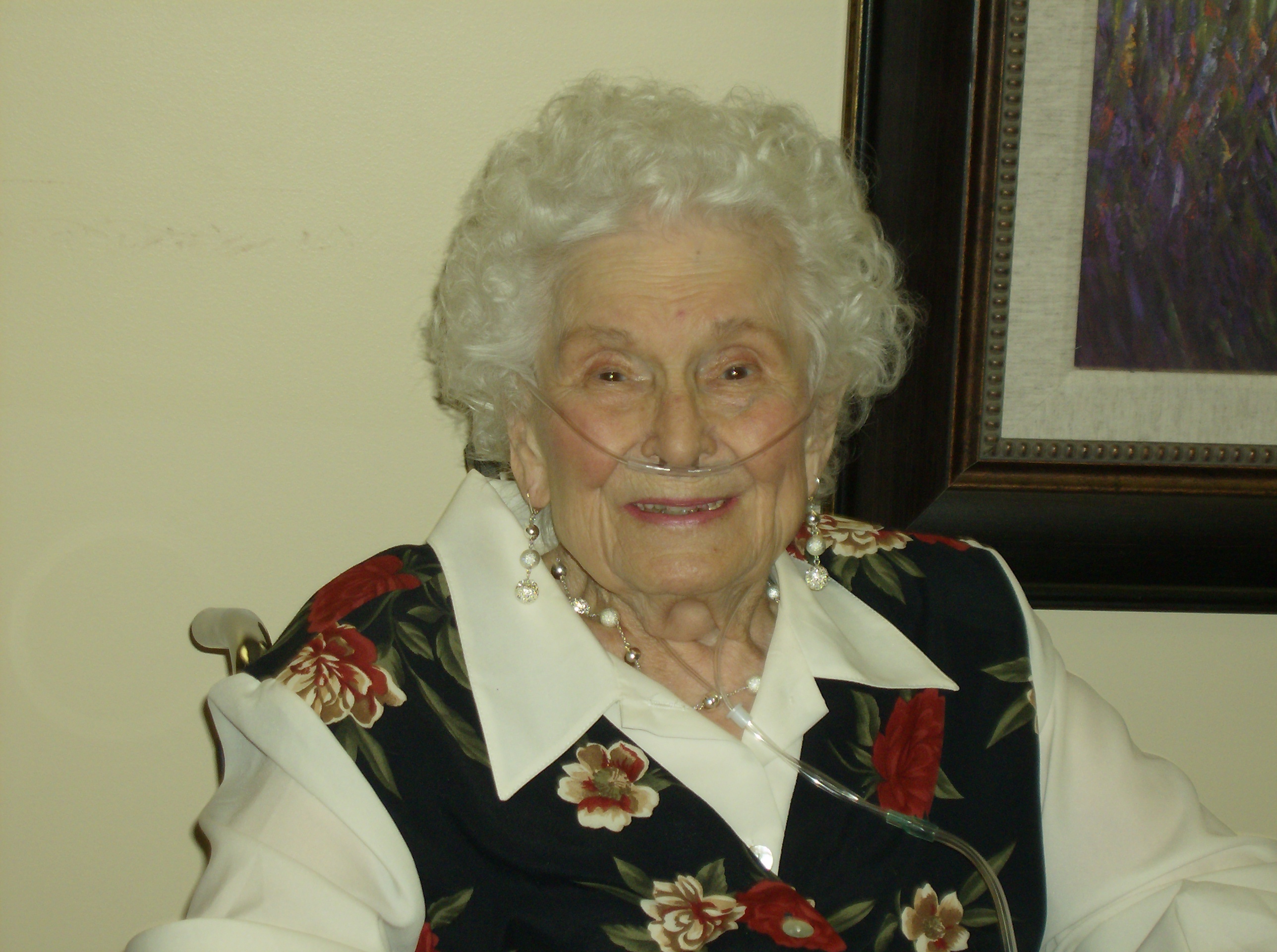
Estelle Catlett. December 24, 2010
Estelle Catlett’s stories spoke of life—and afterlife. Hovering murkily between fact and fiction, tales of her encounters with the supernatural made my grandmother as much a spiritualist as a storyteller in my eyes. I listened with fascination, and admittedly some doubt, to her several “ghost stories” about the lingering spirits of deceased family members. She told me many times, for example, how, after my grandfather passed away in the mid-90s, he used to “visit” her, turning on lights when they were off, especially the colorful ones for Christmas, their favorite holiday. One of these “visits” plays a part in the story that follows.
In the last decade of her life, my grandmother suffered terribly. Pulmonary hypertension, COPD, and years of smoking left her tethered to an oxygen tank and fighting each moment for breath. She could no longer do many of the things she loved and told us about in her stories, and too many times I saw tears course down her proud face as the despair she stubbornly held at bay washed over her. She wanted to escape her suffering, and yet that stubbornness for life that strengthened her for over eighty years persisted—even after a night of near suffocation in late November 2010 that landed her in the emergency room of Richmond’s Chippenham Hospital.
That night, I met my cousins, aunts, and uncles in the waiting room of the ER and passed through the door to the wing where my grandmother was receiving care. As I stepped into a small room filled with pulsing screens, anxious faces, and the sound of air hissing through the oxygen mask swallowing my grandmother’s nose and mouth like the jaws of some desperate serpent, I took her warm hand in mine, the same hand, purpled by needle pricks and ruptured vessels, whose warmth I would feel a little over a month later when her heart made its final beat.
Congestive heart failure put my grandmother through several long weeks at the hospital after that night in the emergency room. Dark purple stains covered her papery skin where her veins had ruptured after dozens of attempts to insert needles and IVs. Her feet were swollen and cracked from fluid retention, and her lips and tongue, dessicated by fluid restrictions, stuck to her teeth and gums. Severe abdominal pain made her doctors fear that a blood clot had formed in her stomach. Tubes sprouted from her nostrils, her arms, from between her legs, from her neck. We could watch her heart pulse to a fast and irregular beat on a screen fixed above her bed. Her condition changed day by day, and her fear of death in the absence of her family stung her each night as we left her bedside. But through her pain and her fears, my grandmother never lost her spirit as a storyteller. By the time she moved to a room in a rehabilitation clinic a few weeks after her admittance to the hospital, she had given the nurses caring for her a heavy dose of stories, stubbornness, and humor in turn. She broke strained silences with witty remarks or that distinctive chuckle betraying some mischief she had devised. For the sake of her family, she held fast to her strength of character: even as I watched a needle plunge into her skin for the twelfth time one day, her face was the portrait of endurance, and she never flinched.
Miraculously, my grandmother made enough improvement to leave the hospital and begin rehabilitation. But at the clinic, her physical and emotional state declined, especially after the Christmas holiday. It was obvious that she had mustered whatever strength remained in her to share her favorite holiday with her family for the last time. By the turn of the new year, the pain and the fears my grandmother had long fought to subdue became more and more visible. She knew death was near, yet apprehension, commitment to her family, or that familiar stubbornness made her resistant to it. She finally began to lower her fists after another one of those “visits” from her husband, as I later learned from a family member. She said that she had seen him standing in the room with her, and she knew that it was time to join him. A few days later, she was back in the emergency room at Chippenham Hospital.
Everything about her room in the ER was the same as it was a month before, and yet she was not. She was barely conscious, and her chest heaved as she drank in the life-giving venom pouring from the mouth of the snakelike oxygen mask. I held her hand again. It was warm, but she didn’t speak. She was later moved to the intensive care unit, where she regained her voice, now raspy and faint. The voice that brought so many stories to life and so many people together now immersed the room in the words of a simple plea: “I do not want to die alone.”
After spending all of the previous day at the hospital with her, my family and I received a call in the early morning of January 9 beckoning us to the bedside of our beloved matriarch, who at that point had perhaps hours to live. We gathered around her—children, grandchildren, great-grandchildren—quiet tears dripping from our cheeks onto the blankets draped around her tiny frame. Above her bed a screen broadcast her erratic heart rate. Someone, maybe a doctor, stepped into the room, opened her slackened eyelids to peer at her now unresponsive brown eyes, and summoned her three sons into the hall outside the room. When they returned, somber, to her bedside, a nurse followed them and removed the mechanisms of life support that by now had taken the place of her will to live. Within the next half hour we shifted our eyes alternately from the heart rate monitor to my grandmother’s body, now growing calm. Her chest rose and fell with less desperation and finally came to rest. Meanwhile, above her the numbers on the screen fell toward zero. This “countdown” to her death gave mortality a kind of rationality that was at once horrific and comforting.
As one faded to zero and her body became still, despair and relief escaped us in muted sobs and soaking tears. A gentle nurse tiptoed into the room and nestled boxes of tissues like paper votives, almost comical in their clumsiness, into the blankets over my grandmother’s legs. My dad and uncles still had their hands in hers. They let go and each of us, her grandchildren, in turn slipped our hands where theirs had been. When I held her hand for the last time it was still just as warm as I had always known. We left her body, finally at peace. On this very day one year ago, my grandmother died as she lived, dignified, with those she loved by her side.
In many ways, my grandmother’s spirit never left on the day of her death. At the viewing, the rooms of the funeral home were filled with vibrant bouquets, the most the staff had ever seen. Stories from her life rose from the lips of the many visitors that had come to wish her farewell. It was as if she were there with us, comforting us as she was accustomed with her humor and her wisdom. To tell the story of Estelle Catlett, the storyteller, is for me an honor and a responsibility. The struggles and strength she found in the days of her illness bear important messages for those nearing the end of life. Too many of our peers face the reality of my grandmother’s worst fear—to die alone. In his essay “The Storyteller,” the writer Walter Benjamin observes, “Today people live in rooms that have never been touched by death, dry dwellers of eternity, and when their end approaches they are stowed away in sanatoria or hospitals by their heirs. It is, however, characteristic that not only a man’s knowledge or wisdom, but above all his real life—and this is the stuff that stories are made of—first assumes transmissible form at the moment of his death.” Stories have the capacity to connect us in powerful ways and dismantle the boundaries between life and memory. My grandmother has taught me that storytelling renders death a transformation. Her spirit, no longer the occupant of an age-worn body, resides now in words, even the words I have written here. Her life did not end on this day a year ago—it became one of her greatest stories.
— LC, 2012
 STELLA