
Estelle: A Storyteller
January 9, 2012 § Leave a comment
Estelle Catlett—my grandmother—was a storyteller. Throughout my childhood I drank in the many colorful tales she told as we sat together at the kitchen table in the house where she lived for over half a century. She recounted memories of her childhood in the Roaring 20s and the trials of the Great Depression. She spoke radiantly of the man who gave her the surname Catlett and over fifty years of faithful marriage. She was the mother of three boys, and stories of her growing children—of my dad in particular—kept laughter on the lips of my sister and me as we were growing up. Tales of gardens and fruit trees, wildlife and beloved pets, carried her love for all things living. Her words blossomed from her tongue just as from her fingertips any plant or animal, healthy or ailing, could find comfort and grow.
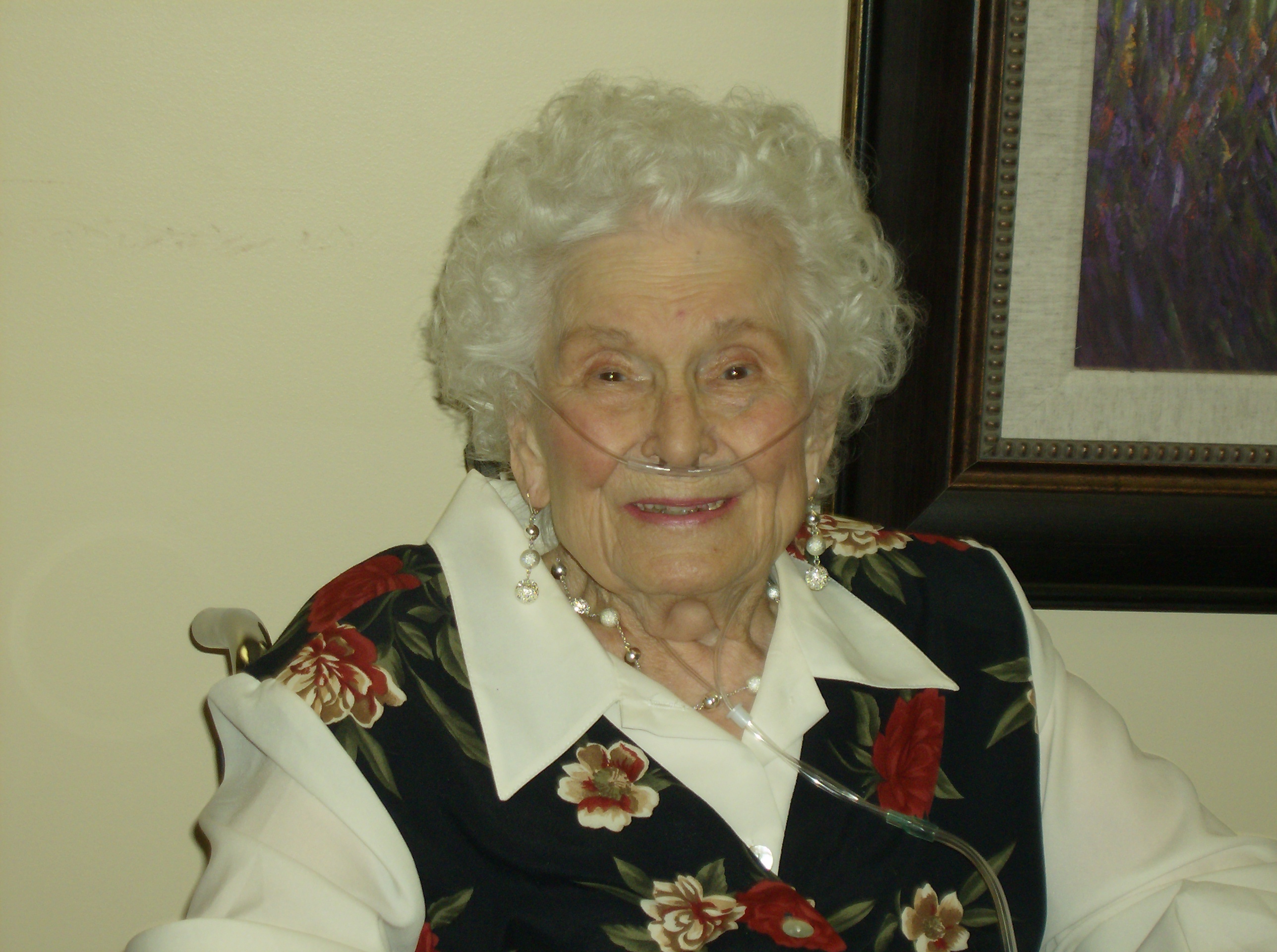
Estelle Catlett. December 24, 2010
Estelle Catlett’s stories spoke of life—and afterlife. Hovering murkily between fact and fiction, tales of her encounters with the supernatural made my grandmother as much a spiritualist as a storyteller in my eyes. I listened with fascination, and admittedly some doubt, to her several “ghost stories” about the lingering spirits of deceased family members. She told me many times, for example, how, after my grandfather passed away in the mid-90s, he used to “visit” her, turning on lights when they were off, especially the colorful ones for Christmas, their favorite holiday. One of these “visits” plays a part in the story that follows.
In the last decade of her life, my grandmother suffered terribly. Pulmonary hypertension, COPD, and years of smoking left her tethered to an oxygen tank and fighting each moment for breath. She could no longer do many of the things she loved and told us about in her stories, and too many times I saw tears course down her proud face as the despair she stubbornly held at bay washed over her. She wanted to escape her suffering, and yet that stubbornness for life that strengthened her for over eighty years persisted—even after a night of near suffocation in late November 2010 that landed her in the emergency room of Richmond’s Chippenham Hospital.
That night, I met my cousins, aunts, and uncles in the waiting room of the ER and passed through the door to the wing where my grandmother was receiving care. As I stepped into a small room filled with pulsing screens, anxious faces, and the sound of air hissing through the oxygen mask swallowing my grandmother’s nose and mouth like the jaws of some desperate serpent, I took her warm hand in mine, the same hand, purpled by needle pricks and ruptured vessels, whose warmth I would feel a little over a month later when her heart made its final beat.
Congestive heart failure put my grandmother through several long weeks at the hospital after that night in the emergency room. Dark purple stains covered her papery skin where her veins had ruptured after dozens of attempts to insert needles and IVs. Her feet were swollen and cracked from fluid retention, and her lips and tongue, dessicated by fluid restrictions, stuck to her teeth and gums. Severe abdominal pain made her doctors fear that a blood clot had formed in her stomach. Tubes sprouted from her nostrils, her arms, from between her legs, from her neck. We could watch her heart pulse to a fast and irregular beat on a screen fixed above her bed. Her condition changed day by day, and her fear of death in the absence of her family stung her each night as we left her bedside. But through her pain and her fears, my grandmother never lost her spirit as a storyteller. By the time she moved to a room in a rehabilitation clinic a few weeks after her admittance to the hospital, she had given the nurses caring for her a heavy dose of stories, stubbornness, and humor in turn. She broke strained silences with witty remarks or that distinctive chuckle betraying some mischief she had devised. For the sake of her family, she held fast to her strength of character: even as I watched a needle plunge into her skin for the twelfth time one day, her face was the portrait of endurance, and she never flinched.
Miraculously, my grandmother made enough improvement to leave the hospital and begin rehabilitation. But at the clinic, her physical and emotional state declined, especially after the Christmas holiday. It was obvious that she had mustered whatever strength remained in her to share her favorite holiday with her family for the last time. By the turn of the new year, the pain and the fears my grandmother had long fought to subdue became more and more visible. She knew death was near, yet apprehension, commitment to her family, or that familiar stubbornness made her resistant to it. She finally began to lower her fists after another one of those “visits” from her husband, as I later learned from a family member. She said that she had seen him standing in the room with her, and she knew that it was time to join him. A few days later, she was back in the emergency room at Chippenham Hospital.
Everything about her room in the ER was the same as it was a month before, and yet she was not. She was barely conscious, and her chest heaved as she drank in the life-giving venom pouring from the mouth of the snakelike oxygen mask. I held her hand again. It was warm, but she didn’t speak. She was later moved to the intensive care unit, where she regained her voice, now raspy and faint. The voice that brought so many stories to life and so many people together now immersed the room in the words of a simple plea: “I do not want to die alone.”
After spending all of the previous day at the hospital with her, my family and I received a call in the early morning of January 9 beckoning us to the bedside of our beloved matriarch, who at that point had perhaps hours to live. We gathered around her—children, grandchildren, great-grandchildren—quiet tears dripping from our cheeks onto the blankets draped around her tiny frame. Above her bed a screen broadcast her erratic heart rate. Someone, maybe a doctor, stepped into the room, opened her slackened eyelids to peer at her now unresponsive brown eyes, and summoned her three sons into the hall outside the room. When they returned, somber, to her bedside, a nurse followed them and removed the mechanisms of life support that by now had taken the place of her will to live. Within the next half hour we shifted our eyes alternately from the heart rate monitor to my grandmother’s body, now growing calm. Her chest rose and fell with less desperation and finally came to rest. Meanwhile, above her the numbers on the screen fell toward zero. This “countdown” to her death gave mortality a kind of rationality that was at once horrific and comforting.
As one faded to zero and her body became still, despair and relief escaped us in muted sobs and soaking tears. A gentle nurse tiptoed into the room and nestled boxes of tissues like paper votives, almost comical in their clumsiness, into the blankets over my grandmother’s legs. My dad and uncles still had their hands in hers. They let go and each of us, her grandchildren, in turn slipped our hands where theirs had been. When I held her hand for the last time it was still just as warm as I had always known. We left her body, finally at peace. On this very day one year ago, my grandmother died as she lived, dignified, with those she loved by her side.
In many ways, my grandmother’s spirit never left on the day of her death. At the viewing, the rooms of the funeral home were filled with vibrant bouquets, the most the staff had ever seen. Stories from her life rose from the lips of the many visitors that had come to wish her farewell. It was as if she were there with us, comforting us as she was accustomed with her humor and her wisdom. To tell the story of Estelle Catlett, the storyteller, is for me an honor and a responsibility. The struggles and strength she found in the days of her illness bear important messages for those nearing the end of life. Too many of our peers face the reality of my grandmother’s worst fear—to die alone. In his essay “The Storyteller,” the writer Walter Benjamin observes, “Today people live in rooms that have never been touched by death, dry dwellers of eternity, and when their end approaches they are stowed away in sanatoria or hospitals by their heirs. It is, however, characteristic that not only a man’s knowledge or wisdom, but above all his real life—and this is the stuff that stories are made of—first assumes transmissible form at the moment of his death.” Stories have the capacity to connect us in powerful ways and dismantle the boundaries between life and memory. My grandmother has taught me that storytelling renders death a transformation. Her spirit, no longer the occupant of an age-worn body, resides now in words, even the words I have written here. Her life did not end on this day a year ago—it became one of her greatest stories.
— LC, 2012
 STELLA
Leave a comment